

Mary’s Igloo, Alaska
In the Eskimo calendar year during the moon of April, the spring weather a big storm coming comes until May and June pass. After the birds of all kinds come to Alaska, the weather is cloudy and overcast. The wind turns into a northerly wind. The ground is exposed from the snow. The lakes have water. The rivers begin running and the creeks begin to flow.
So begins a legend of the Kauwerak Eskimo people of the Seward Peninsula in Alaska, chronicling a time summer didn't come, a year with two winters and no summer. A year of hunger. The tale follows an infant and his mother Napakhuk, the lone survivors of starvation. It tells the story of a trek from a tiny coastal hamlet a hundred miles south of present-day Nome to safety
That was certainly generations ago if it happened at all. Now, most of the Kauwerak tribe lives in the town of Teller, an hour's drive from Nome. The legend of the year with two winters was one of the stories they heard growing up.
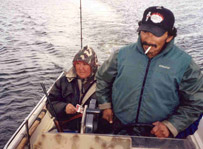
It's Thursday morning in Teller. As a weather bulletin warning of high winds blares from a nearby radio, Thomas Ablowalak and his uncle Norbert Kakaruk, modern members of the Kauwerak tribe, are making plans to boat 50 miles inland. Thomas and Norbert pay a lot of attention to the weather. They have to. They hunt and fish in the wilds of Alaska, and today they're going to the village where they were born and raised: Mary's Igloo. It was in that village where their ancestors passed down the story of the year with two winters. Norbert says some legends are just stories. But he says this one really happened.
Mary's Igloo was a gold-rush boomtown and was once the tribe's largest settlement. Now it's abandoned. But even today, for those who still follow traditional ways, it is, Norbert says, a source for winter staples. When Thomas and Norbert were young, bears didn't harass people here. Now across much of the mostly-emptied region bears have practically taken over. Arriving at Mary's Igloo, they encounter fresh tracks of a grizzly bear. One or more grizzlies may be hiding in the waist-high grass. Even armed with two high-powered rifles, the men are jumpy and anxious to be on their way. Norbert fires his rifle in the air to ward off the bear. Legend has it that before the year of two winters the Kauwerak people were also at odds with the animal kingdom and the calamitous weather was divine punishment.
Of course scientists like Columbia’s Gordon Jacoby don’t believe in supernatural explanations for even strangest natural events. Jacoby believes the cold summer of legend can be explained by an equally catastrophic occurrence four thousand miles east of Alaska, in Iceland. In 1783, the same year that produced the odd tree ring in Alaska, Iceland’s Reverend Jon Stingrimsson, made the following observations in his book, Fires of Earth:
Around midmorn on Whitsun, June 8th 1783, in clear and calm weather, a black haze of sand appeared to the north of the mountains nearest the farms of the Sioa area. The cloud was so extensive that in a short time it had spread over the entire Sioa area and part of Fljoshverfi as well, and so thick that it caused darkness indoors and coated the earth so that tracks could be seen
That summer the earth in Iceland cracked open and lava spewed out of a fissure some 20 miles long. This volcanic upheaval, known as the Laki eruption, exploded over and over in the following months. It produced the second largest lava flow ever witnessed. Three cubic miles of liquid rock poured out of the volcano–enough to build the Great Wall of China a dozen times over. More importantly, a hundred million tons of sulfur and toxic fluorine and chlorine gasses were emitted. Vegetation died and livestock perished. One quarter of the island's inhabitants died from starvation or poisoning. Some of Laki's gasses combined with water vapor in the air, forming a dense fog. The cloud was carried in high-altitude winds around the world. It touched down first in Europe, where the sun dimmed and turned eerie red. Fall came early making leaves fall from the trees. That winter Europe, North America, and many other places in the northern hemisphere experienced record-breaking cold. People talked of the arrival doomsday.
Dendrochronologist Jacoby believes the 1783 eruption also brought on the Kauwerak's frigid summer in Alaska. Eleanor Highwood a scientist at Reading University in England, has conducted studies using a computer model of the climate to see if he could be right. In her research Highwood calculated temperatures throughout the northern hemisphere with and without the eruption. Highwood's computer model shows that the eruption did cause cooling in Alaska though not a chill as deep as Jacoby’s tree records show actually occurred. She says she’s not yet convinced that the frigid summer was caused by Laki, though she says the jury is still out.
Though their techniques are completely different, scientists like dendrochronologist Gordon Jacoby and climate modeler Eleanor Highwood are all striving to understand, and perhaps forecast, earth’s climate. It might seem surprising that the traditions of Alaska's Kauwerak Eskimos and the scientific investigations of these researchers intersect. But if there is one thing climate researchers are learning it is that Earth is one system of cause and effect where a disruption in one place can have far flung repercussions. Benjamin Franklin may have been the first scientist to notice this fact when he postulated that a volcanic eruption, by blocking the sun's rays, caused cool weather thousands of miles away. The year was 1783. The volcano was Iceland's Laki outburst.
- Listen Fire and Ice, Dan’s radio documentary on the strange connection between a volcano in Iceland and famine in Alaska