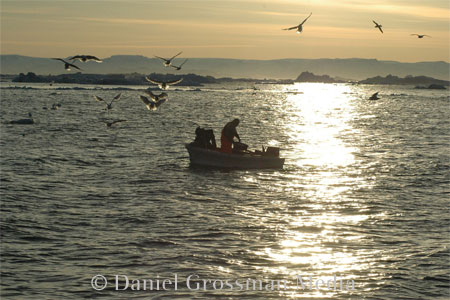
Ilulissat, Greenland
The Greenland Ice sheet is a massive pile of ice two miles thick in its center and the size of the U.S. east of the Mississippi river. It contains enough water, if it melted, to raise sea levels worldwide by about 23 feet. Recent research shows that the Greenland Ice Sheet is melting faster than previously thought possible, making a near collapse of the Ice Sheet conceivable in a matter of centuries. Conservative estimates predict that sea level will rise by about 2 feet by 2100. Many researchers familiar with changes taking place in Greenland say much faster increases could occur. Ice is lost by surface melting and by calving, where chunks of ice break off onto land or the ocean. The world’s fastest moving glacier is the Jacobshavn Ice Fjord, adjacent to Ilulissat. Jakobshavn doubled its speed in the late 1990’s. It calves about 50 billion tons city-block-size chucks of ice every year.
I chartered a fishing boat to the Eqi glacier at the edge of the ice sheet. There I experienced (and recorded the sound of) calving firsthand. Later I flew by helicopter to Swiss Camp on top of the ice sheet to learn about changes in Greenland’s ice and theories for what might be causing them.
- Listen to podcast produced for National Geographic about Swiss Camp
Related Links
Ilulissat, Greenland
- Listen to Meltdown Dan’s documentary about the impacts of global warming on the world’s ice (including that of Greenland)
- Listen to the Swiss Camp segment of Meltdown
- View photo gallery of Greenland and the Arctic
- View photo gallery of ice threatened by global warming
PHOTO GALLERY OF SWISS CAMP
- View Dan's Photographs of SWISS CAMP